
Are the People of Dominican Republic Racist or Not?
You may have heard the allegations before. Are Dominicans racist? not claiming to be "Black"? Is it a misunderstanding? Quarrels with neighbors on the west? Not true they accept all people?

“I No Black, I Dominican”
I’ve heard arguments from both sides of this argument. I don't think anyone can come to a conclusion if they are not hearing the other side. Some may hear one side and come to a conclusion. Let's tackle a bit of history first. In 1492 the Spanish brought the first enslaved Africans to the western world. To the Island which today is known as Dominican Republic. At the time the Island was not divided, and it was named Ayiti or Quisqueya while being occupied by indigenous people Taíno. The Spanish renamed the “whole” Island to La Hispaniola. By referring to the “whole” Island is because at that time Haiti the neighboring country did not exist. Not until 1697, after decades of gruesome war between the French and Spanish. The Spanish ceded the Western part of the Island to the French. The two European powers were at odds from the beginning. In 1804 Haiti became independent from the French. In feb 27, 1844 the Dominican Republic declared its independence from Haiti.
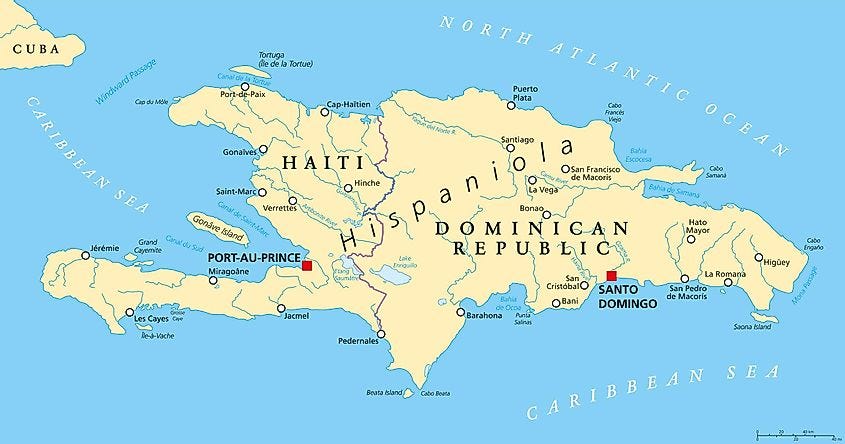
In March 1844, 30000 Haitian soldiers under the order of then President Charles Rivière-Hérard invaded Dominican Republic.
June 17, 1845, Dominican Republic forces from Las Matas, under the command of General Antonio Duvergé, invaded Haiti.
Both sides invaded each other and who’s to say that there isn’t harsh feeling that remains? Disagreements over recent years have come up, but nothing leading to all-out war.
Separated by a borderline. The two countries speak different languages and are going in two completely separate economic directions. Dominican Republic is on its way to being one of the biggest economies in Latin America. Haiti not showing any signs of progress while being the poorest country in the Western Hemisphere. So, you might have guessed it by now, the racist stigma on Dominicans stems from their history with Haiti. It's not about the fact that Dominicans are fairer skin than Haitians who are darker skin. That’s completely false, because many Dominicans are dark skinned. No family in Dominican Republic will you not see any darker skin (black people). Dominicans are a mix of African, European and Taíno decent. One of the most African diasporas in the world. How can you be racist if the people you're supposedly racist towards can look just like you or family members? Sure, you will have ignorant, uneducated fools that will have prejudice against others. That happens on both sides, once you take a side without seeing for yourself. Sure, there could very much be ignorant Dominicans that hate someone based on them being darker skin. These are all possible scenarios, but not enough to consider the whole culture racist. To only be racist to Haitians alone, but fine with other Caribbean and African Americans? That’s not by definition racist. “I no black, I Dominican” can easily be explained. First the word “Black” is an English word, correct? well, Dominicans nor Haitians have that word in their vocabulary. Secondly, Africans never used the word “Black” either to describe themselves. Thirdly, the word “Black” at first was defined as “wicked, evil, threatening” (in the English dictionary). So, who would want to call themselves “Black” knowing its demeaning? Lastly, Dominicans don't refer to themselves as “White” either. That's never mentioned though.
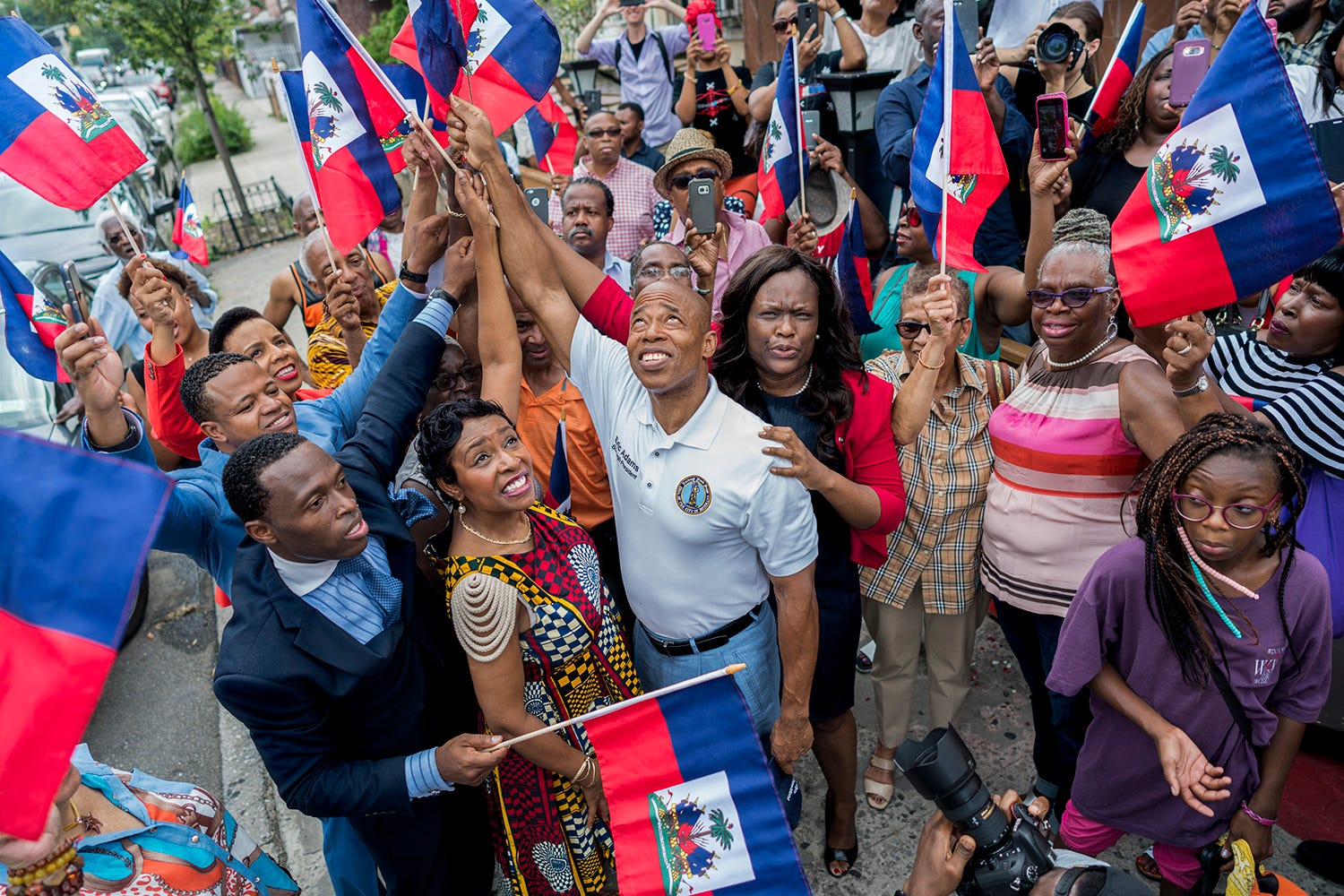
In all reality, the racist allegations towards Dominicans are some of the most non logical insults. These allegations have caught on like wildfire from a majority who've never even been to the DR. Or experienced any issues in the DR, because of their skin complexion. Again, not all Dominicans are mixed looking light skinned with straight hair. There are Dominicans that have the same skin complexions as Haitians. They too originate from Africa and were on the Island for 100s of years under colonial ruling. Today many hard-working Haitians live prosperous lives in Dominican Republic. They have children in the DR, a lot of Haitians work on farms, they live in the city and some of the rural country areas amongst the Dominican people. There’s lots of Haitian/Dominican love couples, with children. Haitian children go to the schools and are treated equally. Haitians are in the same churches as Dominicans praying and worshiping along side together. There’s no discrimination towards any “black” people. It's been reported that 79% of Haitians feel safe in Dominican Republic.
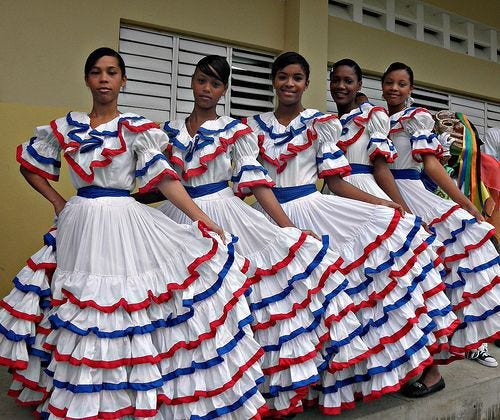
In conclusion, throughout history many countries have had problems with each other that were separated by a border. Governments are never too pleased when another poorer country is using the resources of their country. United States of America has half of the country wanting to keep Mexicans out, and we don't say collectively all Americans are racist to Mexicans. Remember the Great Wall of China. Germany split up once. Once upon a time there was the Soviet Union. Modern day a lot of Panamanians are taking out frustrations with neighboring country Colombia. No one dares to throw that racist term against none of these examples. So, are Dominicans racist? The answer is a clear no. If they were the correct term would be called “self-hate”. Dominicans don’t hate “black” people or any other race. They identify by their nationality and not by a color as many other countries in the world also do. Race was created to divide people through classism. Dominicans don't grow up talking about race, as American culture does. You're not discriminated against in DR for being darker skin. We all can learn a lot from Dominicans and just be the human race, rather than going by dividing colors. Darker skin complexions are not going to get you harmed or have racial slurs yelled at you in the DR. They don't show any hate to any race, not even towards themselves. It’s a very loving and welcoming culture. The reason why so many millions visit this paradise every year.
J,
I’ve been meaning to respond to you for some time and never got around to it. I want to begin by expressing my appreciation because you approached this conversation with a level of maturity that, frankly, I haven’t always seen among Dominican Americans engaging these topics.
A few important corrections. On February 27, 1844, the Dominican Republic did not gain independence from Spain — it declared independence from Haiti. The first declaration of Dominican independence from Spain occurred in 1821, just months before the Haitian occupation began. Additionally, Dominican forces never invaded Haiti as an act of aggression. General Antonio Duvergé entered Haitian territory only during limited offensive operations after Haitian forces had attacked Dominican soil. These were tactical maneuvers in the context of defensive warfare — not campaigns of conquest.
The Dominican independence movement itself began as a diplomatic act of separation. The newly formed Dominican government, the Junta Gobernativa, formally notified the Haitian president and requested recognition of Dominican independence. The Junta explicitly stated that it did not intend to retaliate or engage in the use of force, and it committed to respecting the private property, lives, and dignity of Haitian authorities and citizens residing in Santo Domingo as they withdrew from Dominican territory.
President Charles Hérard received a letter detailing the reasons for Dominican separation, along with the formal Manifesto of Independence. He rejected the declaration and ordered the invasion of Santo Domingo in an effort to suppress Dominican sovereignty. The conflict that followed lasted from 1844 through 1856 and was characterized by repeated Haitian incursions attempting to re-occupy Dominican territory.
Regarding the island’s name and indigenous history, there were several indigenous names for the island prior to European colonization — Bohío, Babeque, Quisqueya, and Ayiti — reflecting the linguistic diversity of the peoples who inhabited it. The Taínos were not the only indigenous group present; there were also Ciguayos, Ciboney, Macorix, among others. What is striking in contemporary discourse is the tendency to position “Ayiti” as the sole authentic name of the entire island — even among some Dominican-American scholars. This framing overlooks both the island’s linguistic diversity and the fact that pre-Columbian societies did not operate under the European concept of a centralized nation-state encompassing the entire territory.
There is also a broader incoherence in the international narrative surrounding Dominican identity. Much of it appears derived from efforts to deconstruct Dominican national identity and delegitimize Dominican nationhood — a political impulse that has historically characterized sectors of Haitian political thought. Dominicans do not reject blackness. What is often misunderstood is that the Dominican nation was constructed as a color-blind national project. That is precisely why you will not hear Dominicans claim that we are “white”; we describe ourselves as mixed. The national identity is civic, not racial.
Haiti, by contrast, was historically constituted as a post-revolutionary Black republic defined explicitly through race. The Dominican Republic developed under a different historical logic — multiracial, Hispanic-Caribbean, and civic in orientation. Conflating the two projects erases their distinct historical trajectories.
Many of the allegations circulating internationally are amplified by activism among diaspora communities, particularly Haitian Americans and some Dominican Americans abroad who have constructed a caricature of Dominican identity detached from lived realities on the island. Notably, Haitians residing in the Dominican Republic often maintain functional, everyday working relationships with Dominicans and are generally less hostile than diaspora political discourse would suggest.
Another persistent claim is that Dominican history reflects systematic efforts to “whiten” the country. The historical record complicates that narrative. The Dominican Republic is home to descendants of freed African Americans who settled in the Samaná Peninsula, as well as Black immigrants from English-speaking Caribbean islands — including the Bahamas, Bermuda, and St. Kitts — whose cultural contributions are deeply woven into Dominican society. These realities do not support the notion of a nation engaged in racial erasure.
Again, I genuinely appreciate your interest in understanding Dominican history more seriously and sharing that understanding with your audience. Conversations like this are important, especially when approached with intellectual rigor and good faith.